

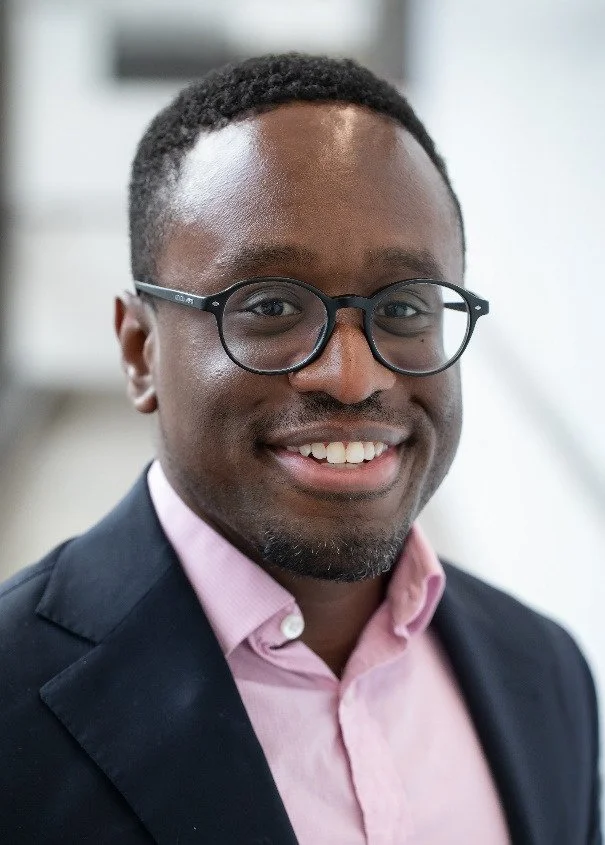
Dr. Jamal Depradine's path to medicine began in Scarborough, where he grew up as the child of Grenadian immigrants. Without family connections to the medical field, his introduction to healthcare came through a University of Toronto summer mentorship program in 2004, when he was in 11th grade. The program was designed to expose Black and Indigenous high school students to the health sciences. Spending time at Mount Sinai and other hospitals, the program introduced Dr. Depradine to what he describes as the magic of medicine.
Growing up in Scarborough, he witnessed disparities in access to healthcare firsthand. These observations shaped his desire to improve not just individual health, but overall wellness. This broader vision led Dr. Depradine beyond clinical care to pursue a master’s degree in Management of Innovation, with a focus on health policy, economics, and system design. Before medical school, he worked at Cancer Care Ontario, examining how cancer programs were funded and how equitable access to chemotherapy and imaging could be ensured across the province. Through these experiences, he came to see medicine as a social enterprise, fundamentally about people and their circumstances. He tries to keep one guiding question at the forefront of every encounter: what can I do to make your life better today?
He was drawn to geriatrics because of its deeply social focus. Many of the patients he works with are vulnerable, living with cognitive or physical impairments. For Dr. Depradine, geriatrics brings together a biopsychosocial approach to care, helping people maximize their independence, regain mobility, and continue participating in their social lives. Recognizing Ontario’s growing aging population, including many aging Black Canadians, he felt it was important to have representation within geriatric medicine. The specialty also provides opportunities for leadership and advocacy around policies and system changes needed to support older adults.
During his fourth-year of medical school, an experience with his mother profoundly shaped how he thought about aging and care. She was diagnosed with cancer at the beginning of his fourth-year and, over the following year and a half, he accompanied her through frequent hospital visits and appointments. For the first time, he experienced the healthcare system not as a future physician, but as a son. He noticed the doctors who took the time to sit down, explain what was happening, ask about fears, and understand what mattered most. Those moments of communication and human connection made a lasting impression and reinforced that medicine extends beyond clinical decision-making, especially when caring for older adults.
Mentorship has been woven through every stage of Dr. Depradine’s journey. The same 2004 summer mentorship program connected him with health professionals and early role models, opening doors that might otherwise have felt inaccessible. His family, particularly his mother, provided another layer of guidance, modelling compassion, kindness, and patience. Despite her passing, she remains one of his greatest motivations for both medicine and what it means to be a good human being. Professionally, he credits mentors such as Dr. Onye Nnorom, Dr. Mireille Norris, and Ike Okafor, from whom he has learned clinical expertise and approaches to academic development.
He also finds mentorship in his patients, learning from their lived experiences and perspectives. For Dr. Depradine, mentorship exists in many forms, and medicine itself is bidirectional. Especially in geriatrics, he believes physicians learn just as much from patients as patients learn from them.
Mentorship, for Dr. Depradine, has often taken the form of brief but meaningful encounters. One such moment occurred in March 2004, when he attended a University of Toronto medical school open house and met Dr. Omole, then a second-year medical student. During their conversation, she took the time to answer his questions thoughtfully and to share information about available mentorship programs and resources. That interaction left a lasting impression. It demonstrated how even a short exchange, when approached with care and intention, can meaningfully influence a young person’s sense of possibility and direction.
Now, as a mentor himself, Dr. Depradine approaches the role with intention. He starts by understanding where each mentee wants to go and how their career fits within their life. He meets regularly with students, residents, and international medical graduates, checking in on both professional progress and personal well-being. He is candid about the challenges and rewards of medicine and strives to lead by example through communication, patience, compassion, professionalism, and respect. He believes every interaction matters, whether it’s a phone call, video chat, or a coffee meeting with a student exploring medicine.
Looking ahead, Dr. Depradine’s vision centres on transforming geriatric care. At West Park Healthcare Centre, where he has worked for four years, the focus is on keeping people healthy in their homes and communities, preventing avoidable emergency department visits through proactive care. The team developed a geriatric day hospital, an outpatient rehabilitation program designed to support people still living at home before major declines occur. He continues working to expand multidisciplinary, community-based models of care that prioritize prevention rather than reaction.
When asked where he finds the most joy in his work, his answer is simple: the people. It’s the patients regaining independence, the families, and the colleagues who share his passion. Without the people, he believes medicine would be meaningless.
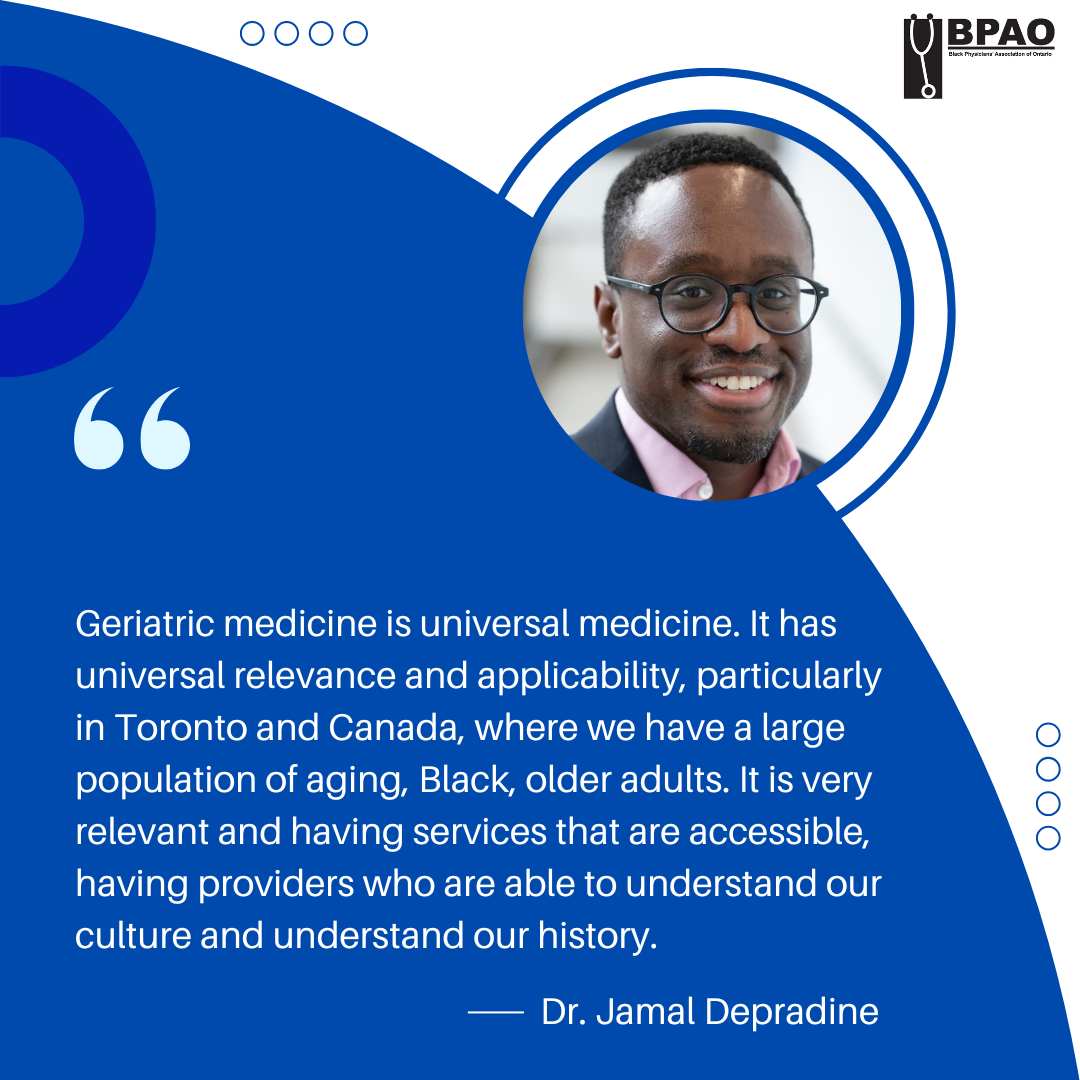
Dr. Depradine notes that geriatric medicine has universal relevance. Everyone ages, and everyone knows older adults. In a city like Toronto, with a large population of aging Black Canadians, accessible and culturally informed care is essential. His work reflects a commitment to helping people live independently, with dignity, in their communities for as long as possible.